|
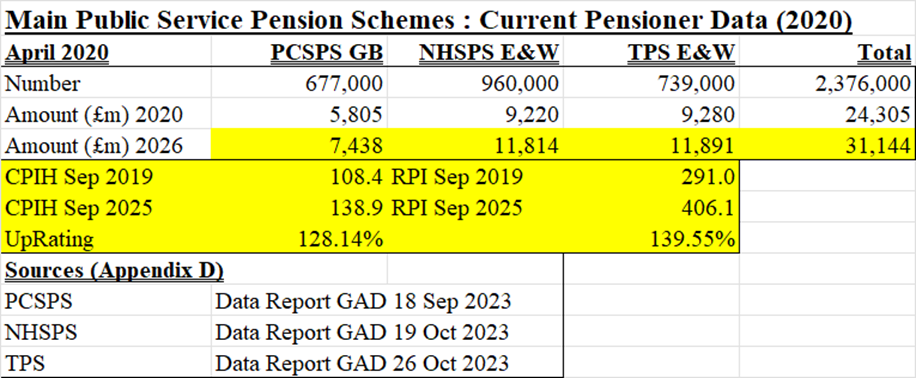
Why is RPI so important? Well, it's not quite as important now as it was but it really used to be. Until 2011, when CPI was adopted instead, public service pensions had been formally linked to RPI movements since 1971. As at Apr 2020, the Data Reports issued for NHSPS (E&W), PCSPS (GB) and TPS (E&W) in late 2023 show total pension outgo was £24.3b pa {summary}.
Indexing in line with CPIH {RPI} between Sep 2019 and Sep 2025, the total outgo would increase to £31.1b pa {£33.9b pa}as at Apr 2026; CPI was virtually the same as CPIH. They are the three largest public service pension schemes but there are many others such as LGPS and those for Scotland and NI. While it is hard to derive a firmer estimate, arbitrarily adding 40% in respect of the other public service pension schemes increases the Apr 2026 total pension outgo to £43.6b pa for CPIH or £47.5b pa for RPI. So shifting from RPI to CPI is likely to have saved around £4b pa over many years, which is a great deal.
Many private sector pension schemes are still linked, whether partially or fully, to RPI but any useful figures are hard to come by. Then there are the index-linked gilt-edged stocks, upon which income and capital payments are currently fully linked to RPI.
For the foreseeable future, even if it is no longer relevant to public service pension scheme benefit increases, RPI will need to be tracked for a long time to come . Unfortunately, the Statistics Authority has decided that the RPI does not comply with Principle 4 (specifically with Practice 5) of the Code of Practice for Official Statistics. Although ONS and Treasury have been forcibly requested to agree to repair RPI, this now seems unlikely to happen. The outcome is set out here.
|